
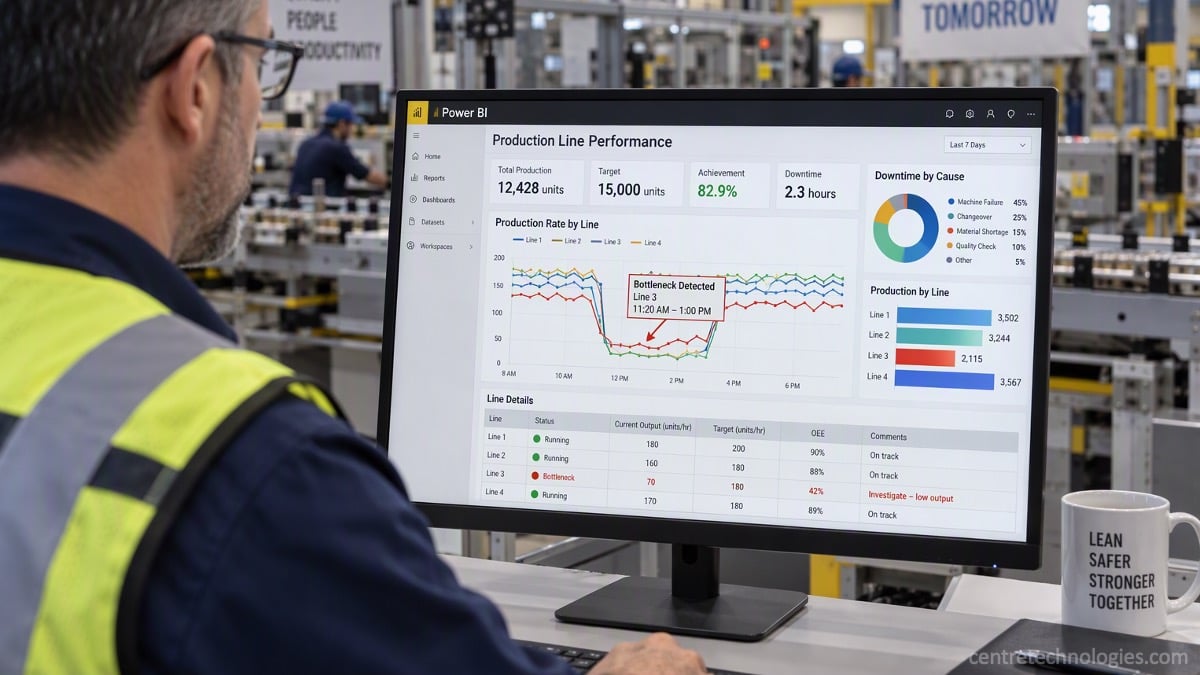
How Does Power BI Help Manufacturers Identify Production Bottlenecks Before They Delay Orders
Power BI helps manufacturers identify production bottlenecks by showing where work stops flowing efficiently through the operation. Instead of discovering constraints after lead times increase or orders ship late, manufacturers quickly see capacity issues, recurring downtime, and production slowdowns while there is still time to respond.
The skinny on how Power BI will help keep production on track:
- The Clues Bottlenecks Leave in the Production Process
- How to Make Faster Production Decisions Using Power BI
- Bonus: YouTube Breakdown of Our Favorite Dynamics 365 Business Central Time Savers
- Why Manufacturers Even Care About Power BI
The Cost of Not Seeing a Bottleneck
Production delays start with a small constraint that gradually slows the movement of work through the plant. Not overnight. A machine begins running slightly below target or a production cell struggles to keep pace with demand. One work center becomes overloaded while the rest of the operation waits for parts. And at first, the issue appears manageable. Unfortunately, though, eventually, unfinished goods begin accumulating, schedules become harder to maintain, and delivery commitments become increasingly difficult to meet.
The challenge is that so many manufacturers still lack complete visibility into current production statuses or problems. Only 16% of manufacturers report having real-time visibility into production across the entire manufacturing process. As manufacturers continue investing in AI and automation through 2027, if you don't have real-time operational visibility, you'll find it harder to identify the problem before they impact customer orders.
Bottlenecks Leave Clues Throughout the Production Process
Bottlenecks create warning signs long before customer orders are affected.
- Work-in-process inventory begins accumulating in the same area of production
- Utilization rates spike at one resource while surrounding operations operate normally
- Throughput decreases despite demand remaining strong
- Downtime events begin creating a measurable impact on output
The average manufacturing facility loses approximately 30 hours of production time per month due to downtime. What begins as a minor operational disruption can quickly become a production constraint that impacts schedules and delivery commitments.
Power BI Turns Your Production Data Into Trends You can View Automatically
Power BI helps manufacturers identify bottlenecks faster because it connects operational data into a single view of the production process.
As manufacturers face pressure to increase throughput without dramatically increasing labor costs, this is a must. Industry workforce research estimates the U.S. manufacturing sector faces a labor shortage exceeding 2.1 million workers in 2026, making efficiency a top priority for production leaders.
For manufacturers, adding more people is no longer the easiest path to growth. Finding and eliminating production constraints is often the fastest way to uncover additional capacity using resources already in place.
Faster Visibility Leads to Faster Decision
You can't just identify the bottlenecks. You've got to find them while corrective action is still possible.
Teams believe they are operating efficiently, only to discover significant hidden production losses after implementing better monitoring. Industry benchmarks show the average manufacturing plant operates around 60% OEE (Overall Equipment Effectiveness), while world-class manufacturers operate closer to 85% OEE. That gap represents substantial untapped production capacity.
As manufacturers build their 2027 growth strategies, improving throughput often provides a faster return than investing in additional equipment or expanding facility space.
Why Manufacturers are Investing in Better Production Analysis
Manufacturers are under increasing pressure to improve output while controlling costs. Federal Reserve data shows U.S. manufacturing capacity utilization remained near 76% in 2026, suggesting many facilities have room to increase production if operational constraints can be removed. At the same time, digital transformation continues to accelerate as manufacturers look for better ways to manage complexity and improve responsiveness.
For manufacturers planning for 2027, the question is no longer whether production data exists but whether teams can identify and act on bottlenecks before they affect customer commitments. We'd love to help you with that. Contact us today if you're pursuing ore automation in 2027.
