Copilot Cowork vs. Claude Cowork: Choosing the Right AI Agent for Your Business
Choosing between Copilot Cowork and Claude Cowork is less about which AI is better and more about the environment your business relies on. Both platforms were built around the same goal: helping employees delegate work instead of spending time managing tasks. While they share a common foundation and vision for both engines , Copilot Cowork is designed to maximize value inside the Microsoft ecosystem, whereas Claude Cowork is built for flexibility across files, tools, and research workflows. The right choice depends on where your data lives and how your teams work, instead of just the outcomes you want AI to achieve.
Inside this comparison of Claude Cowork and Copilot Cowork:
- The Origins of Claude and Copilot Cowork Compared
- What Copilot Cowork and Claude Cowork Have in Common
- Biggest Difference: Copilot Cowork is Designed for Microsoft-centric Businesses
- How Claude Cowork Appeals to Research-driven Businesses
- YouTube Breakdown: AI Bootcamp
- Which AI Agent Should You Use in Your Business?
How Claude Cowork and Copilot Cowork Started
Both Claude Cowork and Copilot Cowork were created to address the challenge of shifting AI from answering questions to executing work. Instead of acting as traditional chatbots, each platform was designed to take a business objective and return completed deliverables for review. While they share a similar vision and relationship, Claude Cowork helped define the category through flexibility and cross-platform work, while Copilot Cowork brought those ideas into the Microsoft ecosystem.
The Origins of Claude Cowork
Anthropic introduced Claude Cowork to help users move beyond simple AI chats and into executing lots of tasks as once. The platform is especially useful for research-heavy and information-driven work.
Several functions helped establish Claude Cowork as one of the first true AI coworker experiences:
- Users can assign a goal instead of creating detailed instructions
- Claude can work across user files, connected systems, and online resources
- Tasks can continue running while employees focus on other priorities
-
The platform is designed to deliver completed work, not just answers
The Origins of Copilot Cowork
Microsoft took a different path. The company spent years weaving Copilot into daily work, helping employees find information faster and reduce routine tasks. As those capabilities matured, Microsoft shifted its focus from helping people work faster to helping work get done.
That vision became Copilot Cowork. Microsoft designed the platform to understand the business knowledge employees create every day. Instead of asking workers to gather context before starting a task, Copilot Cowork can use existing company information to produce more informed results. This is very similar to how Power BI reporting automated and aggregates data across your ERP system.
The relationship between the two platforms is also worth noting. Microsoft publicly stated that it worked closely with Anthropic and integrated the technology behind Claude Cowork into Microsoft 365 Copilot. Industry reporters also said that Claude Cowork served as part of the blueprint for the Copilot Cowork experience.
What Copilot Cowork and Claude Cowork Have In Common
At their core, both platforms are designed to help people hand off work.
Instead of managing every task manually, users describe a goal, and the platform takes it from there — gathering information and returning a finished result for review. This helps employees spend less time organizing information and more time acting on it. Across demos and reviews, both platforms are described as tools that focus on task execution for the user.
Both platforms share several key strengths. they both can:
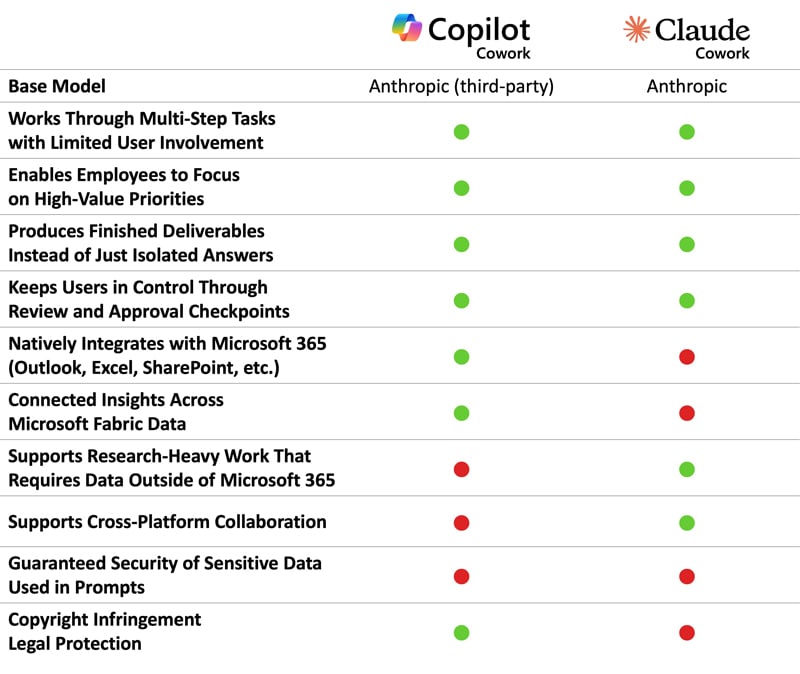
- Work through multi-step tasks with limited user involvement
- Keep work moving while employees focus on higher-value priorities
- Produce finished deliverables instead of isolated answers
-
Keep users in control through review and approval checkpoints
Copilot Cowork appeals to Microsoft-Centric Businesses
Microsoft built Copilot Cowork around the idea that work becomes easier when information is already connected. Instead of asking employees to search for background information before starting a task, Copilot Cowork can build on knowledge that already exists throughout the Microsoft environment. This helps the platform understand priorities and produce more useful outputs. Even better, several independent comparisons note that Copilot Cowork becomes more useful as an organization's Microsoft environment grows.
Copilot Cowork is even stronger for companies that use Power BI and Microsoft Fabric. When performance and trend insights are connected to Cowork, the platform has a clearer view of what is happening across the organization, so you get more meaningful results.
Imagine a sales manager preparing for an important customer conversation. Instead of relying only on emails and meeting notes, Cowork can also understand the business story behind the account. A finance leader reviewing budgets can benefit from the same connected experience because business conversations and operational insights can work together. Microsoft's vision for Cowork is built around connecting work with business intelligence so employees can act faster and with greater confidence.
This connected Microsoft experience is one of Copilot Cowork's biggest strengths.
However, there is a trade-off some analysts have flagged: Copilot Cowork's current lack of support for local computer use and third-party tools outside Microsoft 365 can constrain its autonomy for workloads that live outside that ecosystem.
Claude Cowork Appeals to Research-Driven businesses
Claude Cowork focuses on flexibility. Rather than building around a specific software ecosystem, it's designed to help users work with information wherever it exists. This approach is valuable when projects depend on research or information spread across multiple systems (not just one Microsoft-centric infrastructure).
It's ability to support research-heavy work and help users make sense of large amounts of information matters most to employees whose jobs already depend on pulling information from lots of different places.
Claude Cowork's value comes from its ability to work across different environments without requiring organizations to centralize everything into one platform. Businesses with diverse software environments often see this flexibility as one of Claude Cowork's biggest strengths (especially when you're integrating Claude Code into your workspace).
Which AI Platform is the Better Fit for Your Business?
The answer depends on where work happens inside your business.
Copilot Cowork tends to fit best when:
- Your organization relies heavily on Microsoft 365 for daily work
- Business context already lives inside the Microsoft environment
- You use Power BI and Microsoft Fabric for business intelligence
- You want outputs grounded in the same data leaders already use to make decisions
Claude Cowork tends to fit best when:
- Your work depends on research/investigation or cross-platform collaboration
- Information is spread across many systems rather than centralized in one
- Teams need to work with data wherever it lives, without forcing everything into a single ecosystem
- Flexibility matters more than deep integration with any one vendor
Neither platform is universally better. The right choice depends on whether your business benefits more from connected business intelligence and organizational knowledge, or from the flexibility to work across many different information sources.
Centre Can Help You Adopt AI Well
Copilot Cowork and Claude Cowork are built around the same goal: helping employees spend more time completing their tasks. The difference is where each platform creates the most value.
Picking the right AI coworker is only the first step. Getting real value out of it takes a strategy built around how your business actually operates. Centre Technologies helps organizations evaluate, adopt, and integrate AI tools like Copilot Cowork and Claude Cowork in a way that fits their existing systems, security requirements, and goals. Explore our AI strategy and adoption services to find out which path makes sense for your business.