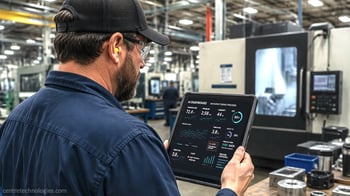

Why Manufacturers Continue Turning to Managed IT Services for Success
Manufacturers in regions like San Antonio and Tulsa face a unique mix of pressures: labor shortages, rising automation, aging equipment, supply‑chain volatility, and an expanding cyberattack surface. As production lines become more connected, the risks and the cost of downtime continue to grow. That’s why more industrial organizations are investing in Secure Managed Services to stabilize operations, secure facilities, and support growth. Let's break down the 5 core reasons this shift continues and why it matters to you.
Navigating this quick break down:
- Core Reason #1: Manufacturers Are at a High Risk for Attack
- Core Reason #2: You Need to Focus on Production, Not IT
- Core Reason #3: You Have Skill Gaps
- Core Reason #4: Production Loss Is More Expensive Than Data Loss
- Core Reason #5: You Need Continuous Monitoring to Feel The Most Confident
- Centre Is Local, and We're Here To Help
Manufacturing experiences highest cyberattack frequency
Manufacturing has become the most cyberattacked industry globally, holding that position for four consecutive years and absorbing 26% of all incidents, with ransomware surging 61% in a single year.
Key factors influencing manufacturers in Texas and Oklahoma:
- Increased connectivity increases pathways for attackers. IT convergence expands the attack surface, especially as legacy machines connect to cloud dashboards and remote vendor systems.
- Ransomware disrupts production continuity. Threat actors now target uptime, not just data, halting production to force ransom payments.
- Manufacturers prioritize cybersecurity investment. 96% of manufacturers plan to invest in cybersecurity platforms, placing cyber resilience alongside throughput and safety as core performance metrics.
What This Means for Local Manufacturers
Facilities in industrial corridors around San Antonio and Tulsa (many with lots of legacy equipment) face the same exposure as global manufacturers, but without the resource pool of large multinationals.
Offloading Necessary IT Burdens to Focus on Production
Manufacturing IT teams juggle plant systems, Supply Chain Management platforms, CNC machines, OPC servers, SCADA dashboards, quality systems, and the daily demands of front‑office IT.
Meanwhile:
- AI-driven attacks accelerate response time demands. Attackers can move from reconnaissance to action in hours, requiring faster detection and response than most internal teams can handle alone.
- Legacy systems increase security burdens. Most manufacturers operate legacy OT systems not built for modern security, and maintaining them strains internal talent.
Operational Impact on Your Team:
MSPs help offload routine workload and monitoring, freeing internal teams to focus on operational reliability, production planning, and modernization initiatives, not troubleshooting break/fix issues.
Filling Skill Gaps and Supporting Modernization
Some San Antonio and Tulsa manufacturers face deep talent shortages. And staffing isn't always an option you can trust.
At the same time:
- Talent shortages hinder security maturity. Many industrial manufacturers report budget constraints and talent shortages as barriers to maintaining security.
- Midmarket plants become preferred targets. Midmarket manufacturers are increasingly targeted because they often lack the staffing depth of large enterprises.
Why Staff Augmentation Matters
MSPs provide specialized OT‑aware security, 24/7 monitoring, and project support without requiring additional headcount or multi‑year hiring cycles.
Production Downtime Is More Expensive Than Data Loss
Manufacturers in San Antonio’s aerospace, defense, and industrial machinery sectors, and Tulsa’s energy, fabrication, and transportation equipment sectors, need reliability, uptime, and operational continuity 24x7.
The data shows:
- Downtime drives financial loss. Attacks on manufacturing create massive operational disruption, with downtime costing an average of $1.9 million per day in major incidents.
- Connectivity eliminates air-gap protections. As OT and IIoT connectivity expands, air gaps are disappearing, and shop‑floor systems are now directly in the blast radius.
Why This Matters Locally
San Antonio’s advanced manufacturing and Tulsa’s energy‑heavy industrial sectors rely on continuous production. Reliable IT/OT monitoring ensures that production lines, safety systems, and supply chain integrations remain stable.
Manufacturers need continuous monitoring and visibility
With tighter supply chain timelines and lean labor, manufacturers can’t afford blind spots. Modern monitoring provides:
- Predictive analytics preventing unplanned downtime. These analytics identify machine or system failures before they halt production. (Based on broader AI‑enabled monitoring across MSP industry trends.)
- Continuous monitoring that accelerates threat containment. Incident detection at machine speed, required as AI‑enabled attacks accelerate.
Is This Relevant for Manufacturers?
Yes, of course. San Antonio’s and Tulsa’s distributed facilities often rely on remote sites and mixed infrastructures. Monitoring ties these environments together for consistent oversight.
Exploring Managed IT Solutions with Centre Technologies
Centre's Managed Services supports manufacturers across Texas and Oklahoma with:
- 24/7/365 monitoring and support
- Zero Trust, vulnerability management, and incident response aligned with your needs
- Predictable cost models so you know what to expect every time
- Local experts and technicians in your back yard who understand the regional ecosystem
We measure success by one metric: How many disruptions your team never has to deal with.
If you want a provider with local presence and enterprise‑grade capability, we’re here to help strengthen your manufacturing operations in San Antonio or Tulsa.